Claudio Villafañe (b. 1989, Córdoba, Argentina) is a London-based painter. His work draws on childhood memory and working-class life in Córdoba, returning to psychological states shaped by protection, exposure, and confrontation.
He works primarily in oils and often combines acrylic and oil in the same painting, using the shifts between surfaces to build light and depth. He paints mostly on cotton duck canvas for its resistance and texture, and regularly works across different scales, including smaller pieces on paper and plywood. He builds his own stretchers and frames, keeping the work physically grounded through a connection to his carpentry and construction background.
Villafañe has exhibited in the UK and internationally, including Tomorrowland’s Remember The Name (Belgium, 2023). His work is held in public and private collections. He lives and works in London.
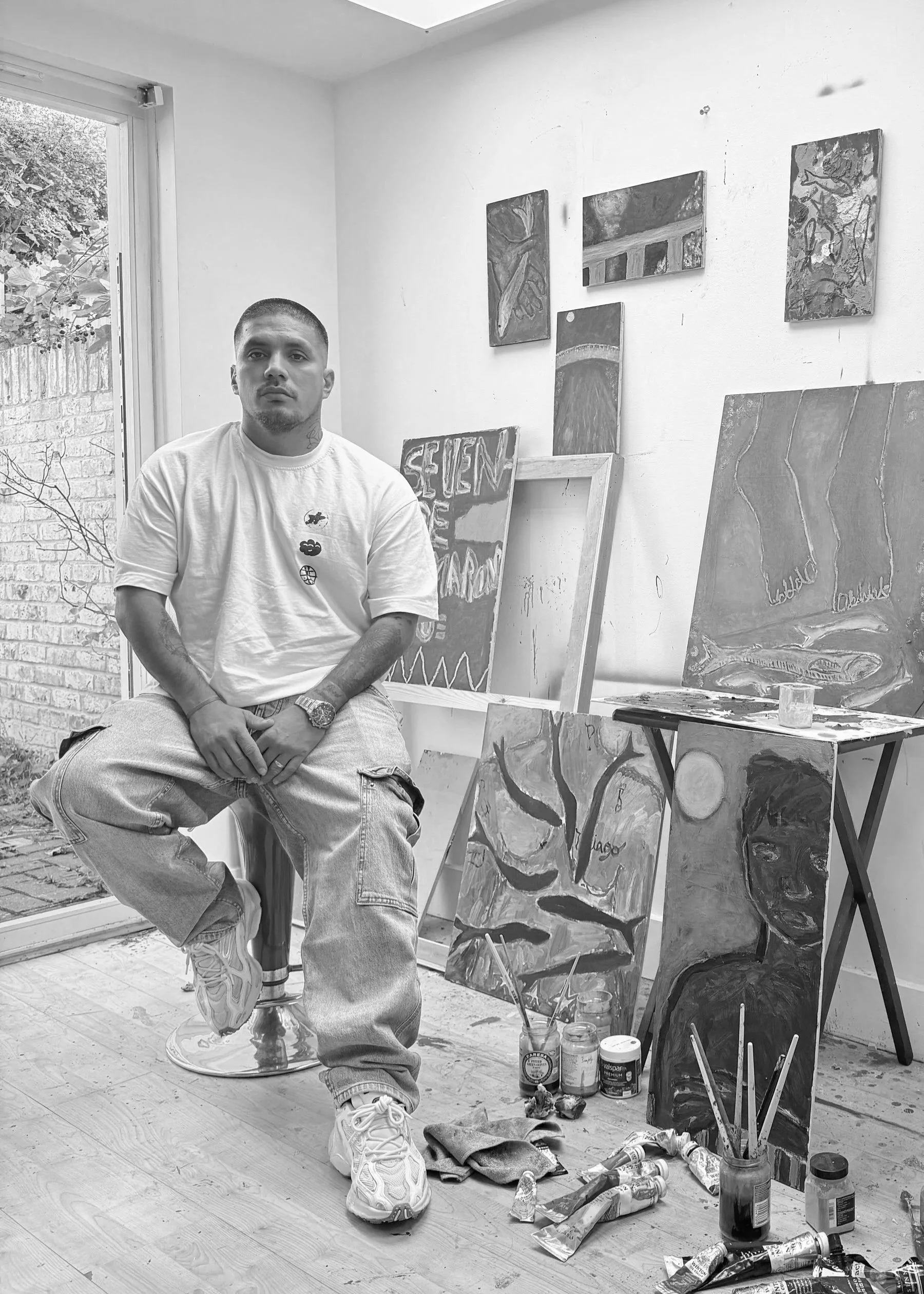
Artist Statement
My work returns to a presence held through forms. It may appear as a figure, an object, or a fragment held in space. The form shifts, but the tension remains.
I paint through images that carry memory rather than describe it. A gesture, a posture, or a simple object can hold the same weight. The work does not aim to narrate but to contain a state, something sensed more than explained.
The paintings move between figuration and object-based forms, held within flattened or unstable spatial structures. Landscape appears as a condition rather than a setting. High or slightly tilted horizons reflect displacement rather than location. These environments echo the afterimage of Córdoba, where I was born, without becoming descriptive.
Material plays an important role in my thinking. I work primarily on cotton duck canvas, whose resistance and texture allow me to work directly and at scale. I often begin with acrylic and return with oil, allowing the surfaces to shift depth and light. I also work on plywood and paper, usually in smaller formats. Building my own stretchers and framing the work keeps the practice connected to my background in carpentry and construction.
Within the paintings I explore the relationship between flat surfaces and visible brushwork. Some areas remain still while others carry more physical gestures. Layers are applied and partially left visible, allowing earlier decisions to remain present. Rather than fully resolving every mark, I allow instinct and accumulated hand movements to determine what stays.
Whether through a figure, an object, or a fragment, the work reflects broader questions of class, resilience, and the ways an environment shapes a person long before they understand it.